 GeologyRocks
Ley Lines
- Login to post a new forum topic.
Rank:

Contact:


Rank:

Contact:
Ley Lines
Sun, 07/02/2006 - 15:21I realize that the Ley Lines are believed by the "woo's" and that they are not real (at least not identifiable using any scientific instruments [downsing rods don't count as scientific instruments!]). However, they think it has some credibility in geology and trying to convince them otherwise is exceedingly difficult. There is an article on Wikipedia (search Ley Lines) that gives a pretty good synopsis and I have also found a link to where a geology professor tried to detect the ley lines, failed, and the believers chalked it up to an idea that the instruments needed to cross the lines to generate a measurable field (but of course nothing to base it on and no follow up investigation).
Although not part of geology as we know it, the ideas like Ley Lines cross into our area of expertise and we should be able to debunk these ideas in a straight-forward manner. I'm looking for some "good bullets to put in my gun" to shoot down these type of arguements. It's similar to debunking dowsers and YEC. Although the whole endeavor may be moot as some of these believers will never be convinced, it may be worthwhile to demonstrate to those on the fence the sound, rational arguements.
Thanks
Canadarocks
Rank:

Contact:
Ley Lines
Mon, 07/03/2006 - 11:00Hello Canadarocks
Daft as this might sound, I've actually lectured on the subject of ley-lines. For Jon's benefit, they are straight lines which are supposed to link various points (natural and artificial) in the landscape. These include: churches, any ancient monument up to about the fifteenth century (tumuli, stone circles, standing stones, hill forts, etc), springs, holy wells, prominent natural boulders, summits, crossroads, field boundaries. In fact just about anything. The term was coined by Alfred watkins in the 1920's, who went on to publish "The Old Straight Track". He thought these were ancient trackways, citing the best example as Salisbury Cathedral - Old Sarum, with various points in between. Other authors (notably John Michell) in the 1960's, revived the idea for the benefit of the Flower Generation, claiming they are lines of energy which our ancestors could tap into, but we can't for some reason, and since then it has surfaced sporadically.
My personal view? They don't exist, and as an experiment try this: get a detailed map of an area (OS maps are ideal) and put a pencil circle around any feature you think might qualify. Now take a pencil and ruler and attempt to join more than four of these points in a straight line. These are your ley lines. You should get quite a lot. Now take a blank sheet of paper of the same size and randomly put little circles all over it, making sure it's about the same number as on your map. Now find alignments and, hey presto! you'll probably get about the same.
Additionally, the Chinese believe in Dragon Lines, which aren't straight but sinuous.
It's a good subject for a debate I suppose, but has little or no basis in geology (even faults don't run in straight lines).
Gus
Rank:
Contact:
Ley Lines
Mon, 07/03/2006 - 13:27Hi Gus,
That's a great idea! I think I'll use your suggestion as a basis for my presentation. I think that the ley line concept may be derived from the basic pattern-recognition phenomenon that we humans have evolved. Just because we might see a pattern in something, doesn't necessarily mean anything is there.
Thanks
Canadarocks
Rank:
Contact:
Ley Lines
Tue, 07/04/2006 - 09:31I think that the ley line concept may be derived from the basic pattern-recognition phenomenon that we humans have evolved. Just because we might see a pattern in something, doesn't necessarily mean anything is there.
Canadarocks
I think you've hit the nail on the head. The same would apply to so-called zodiacs in the landscape. There's supposed to be one at Glastonbury (unsurprisingly) but I couldn't make it out at all when I saw it in a book. There's probably one in my back garden as well, and on the tortoise, and in the ketchup splatter on my plate.
Glad to have been of help though.
Gus

Rank:

Roles:


Contact:


Ley Lines
Wed, 07/05/2006 - 18:25Gus' suggestion is the best; it looks like pattern recognition to me. If you draw enough lines, they will, sometimes, line up with significant localitites. for example:
http://www.greatdreams.com/newline.gif
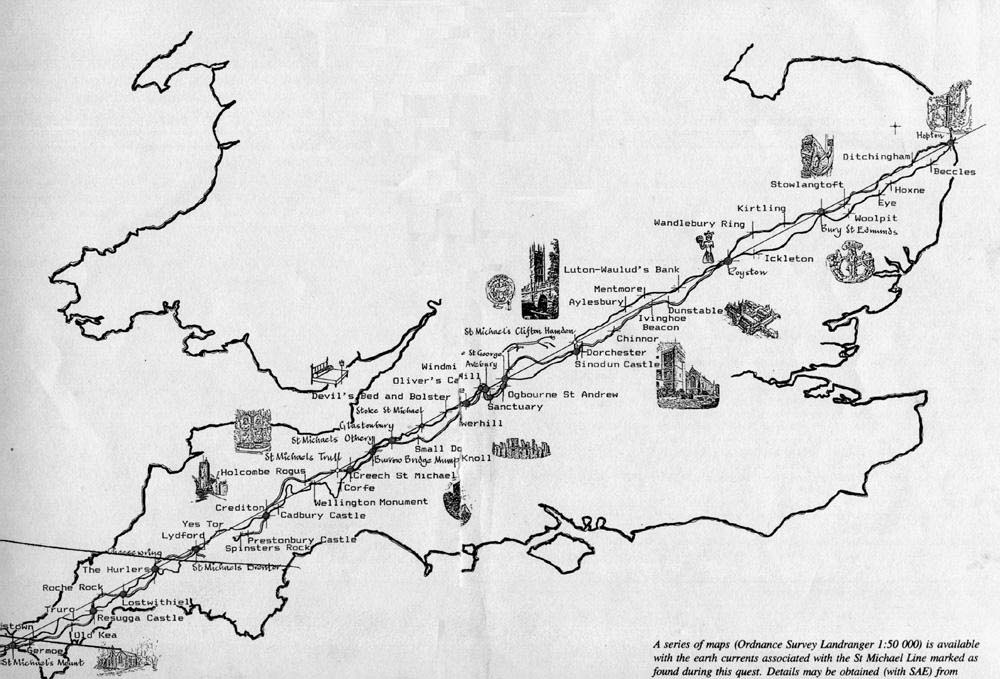
See anythig significant on the magnetic or gravity map?
http://194.66.252.141/website/gdi/viewer.htm?mainserv=geophysics&Title=GeoIndex
Nope...
Jon
Rank:

Contact:
Ley Lines
Wed, 07/05/2006 - 19:01sure sounds like hogwash to me. I think sometimes people grasp at whatever they can to help explain life or that there's something more to it. When it seems (to me anyways) we're merely on a rock that just happens to be the right distance from the sun, contains the right amounts of the different elements, and has gravity. I think many occurrances on our planet stem from the randomness of mother nature along with a few basic processes.
the fact that there can be thousands or millions of these lines drawn on the planet and in all different directions further leads me to believe they are nonsense. To me something has to be at least somewhat rare to be significant in this regard. the map in post #13 of the link Dan Luna posted is what I based my assessment from.
Rank:
Contact:
Ley Lines
Mon, 09/18/2006 - 03:38I remember reading an article about Cornwall ages ago and an explanation as to why so much (alleged) paranormal activity occurs. Apparently it's because of all the granite in the ground. Anyone read about this?
Not sure how many ley lines are in Lancashire though...hmm, wait a minute, there's Leyland - do all ley lines lead to Leyland?
Rank:
Contact:
Ley Lines
Mon, 09/18/2006 - 07:57There's been a lot of cobblers written about paranormal activity in Cornwall. It's apparently a psychic/UFO/piskie hotspot, but not as much as it used to be since the CUFORG (Cornwall UFO Research Group) folded about 4 years ago. This happened just after a lecture I gave them about paranormal phenomena in mines, all of which had rational explanations, and the very public argument which followed, in which I referred to a "genuine" photo of a UFO over Truro as a blurred picture of a car fog light.
You can probably guess I'm a skeptic. They shouldn't have invited me to speak. And I didn't get reimbursed either! The cheek.
Gus
Rank:
Contact:
Ley Lines
Mon, 10/02/2006 - 08:29Radon is created when uranium isotopes break down in granitic rocks. However, in Cornwall, the highest counts occur in the vicinity of a microgranite called elvan which occurs in dykes. Where this has been quarried (and subsequently infilled), you get an even higher count.
Gus

Rank:
Roles:
Contact:
Ley Lines
Mon, 10/02/2006 - 17:44It's ages since I last set foot in Cornwall, when I was at University in fact, went to Wheal Jane to see the tailings dam, the reed beds and the environmental amelioration.
If I remeber correctly, back to those far gone hazy days, it was a lecturer called Kate Farr who organised that trip. I believe she was Cornish. Some say she may even have been a piskie...
Rank:
Contact:
Ley Lines
Tue, 10/03/2006 - 03:28I went on a holiday to St Ives in 1998 with my mum, we went on a Shearings coach and it was full of pensioners (in itself, a scary experience. can u imagine how unnerving it was for me, I was 15 then to be the only person under 30 stuck on there?) Anyways it was foggy and the driver took a wrong turn and we got real lost out in the wilds of Cornwall. We stopped to ask the locals for directions, they gave us weird looks, man, I was freaked out. They said, "you go down that road, you go to die"
I was like, whoa, what the heck? But they were right, coz that road was on the edge of the cliff, and the coach inched along, with bits of rock tumbling from the cliff and the sea raging below. What an adventure!
we eventually made it to the hotel and had a great holiday!
Methinks the ley lines led our coach astray!
Rank:
Contact:
Ley Lines
Thu, 10/05/2006 - 00:52They said, "you go down that road, you go to die"
They probably meant "you go today" because if you went tomorrow the road would have disappeared due to cliff erosion.
Gus
Yup, I guess that could have been it.
Although we could have died anyway, had the road crumbled into the sea while we were driving along it, but anyhow it didn't and that's why I can post here now.
Rank:

Contact:
Ley Lines
Tue, 10/10/2006 - 14:52How would a bus/coach stand up to falling into the sea from a substantial height?
Would it do what movies say and sort of float for a while, allowing passengers to climb out.
Or would structural integrity be lost immediately and it goes to the bottom like a large bus shaped rock!
Just wondering, because I doubt designers take that as a specification!
Rank:
Contact:
Ley Lines
Tue, 10/10/2006 - 16:37I say it would depend on the number of holes in the bus. The water can only get in when air is released, and I think as long as there is a sufficient amount of air trapped inside, it will float. problem is....to get out you have to create holes. though I would think that as long as the bus landed right side up, you could use those escape hatches at the top with good success. if it lands upside down, well........that's not so good.
so i guess the moral is....if you're going to plunge over a cliff into an ocean in a bus, try to land upright.
Rank:
Roles:
Contact:
Ley Lines
Wed, 10/11/2006 - 16:04Hmm, from what I remember, he came from Wolverhampton.
That explains quite a lot, probably thought the bus would fly like some magical Harry Potter-esque Ford Anglia.
I knew a chap who had an Anglia, it was in perfect condition except for the badge; the An was falling off the glia
Rank:
Contact:
Ley Lines
Wed, 10/11/2006 - 20:22theape has a Ford Dagenham dustbin Fiesta, this can fly but only because the brakes fail whilst traveling at high speed before a cliff, and there would need to be a hill at the top of the cliff because the engine probably wouldn't start and the handbrake wouldn't hold it.
Rank:
Contact:
Ley Lines
Wed, 10/11/2006 - 21:43my nanna drives a real old car; it's a blue Morris Marina, which she absolutely refuses to be parted from. it's older than me and I'm 23. Really though, it's a fond memory of my childhood as she used to pick me up from school in it. Over the years it's been improved with various things, i.e, converted to unleaded, had a new radio installed etc, keeps passing the MOT though.
Rank:
Contact:
Ley Lines
Thu, 10/12/2006 - 07:15Hmm, an interesting excursion here, from ley lines to bus wrecks to who's got the worst car. I used to have a Talbot Horizon which had door problems. For the last year of its life the only way to get into it was via its hatch (it was a hatchback). One day, on the way back from a rescue, I had a brief nap and drove it into a wall. Miracle! - the front driver's door opened, but the rest of the car was destroyed.
Gus
Rank:
Contact:
Ley Lines
Thu, 10/12/2006 - 08:04What James has forgot to mention is that my:
Ford Dagenham dustbin Fiesta
Is actually a nice s-reg 5 door car which could get to 100mph, and back to 0 again (using brakes and accelerator), before his car has warmed up.
He happens to have a bogey-green "camp lion", Peugeot diesel. This car can be heard over jet engine noise levels.
But one thing I have to congratulate James on is his bravery getting in a car like that!
Rank:
Contact:
Ley Lines
Thu, 10/12/2006 - 13:13bogey-green, Peugeot diesel
I would just like to say I am proud of my car
I recommend a change of subject or this car thing could go on for ages.
How about this:
If David Cameron was a rock would he be gneiss or schist.
(I go for the latter).
Rank:

Contact:

Ley Lines
Submitted by canadarocks on Sun, 07/02/2006 - 03:49.I'm wanting to perhaps give a talk about geology to my local skeptics group and I thought discussing Ley Lines would be appropriate, but I don't know of any good info on the web about this crackpot idea. Has anyone come across some interesting links?
Thanks
Canadarocks