
The Use Of Diatoms As Palaeoenvironmental Indicators
Mon, 03/12/2007 - 13:08

About the author
Benauld
Introduction
Diatoms are microscopic, photosynthetic algae (which due to the yellow-brown chloroplasts they contain are sometimes referred to as golden algae). Comprising one of the most common types of phytoplankton, they are found in a diverse range of environments from freshwater to saline oceanic waters. It is estimated that 20-25% of all the organic carbon fixation on Earth; via photosynthesis, is attributable to diatoms - in large due to their great abundance.
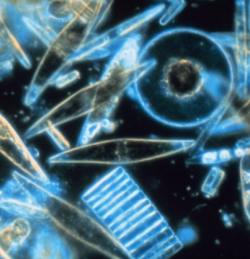
Figure 1: Diatoms through a microscope. Courtesy of U.S. National Oceanic and Atmospheric Administration.
Characteristics
- Photosynthetic, unicellular algae containing pigments, but possessing no flagella or pseudopodia. Also capable of absorbing nutrients in addition to producing them.
- Range in size from 5μm to 2mm, but are generally ~40μm.
- Secrete a frustule or test, composed of silica, which under favourable conditions can be preserved. Each frustule consists of two valves, which fit closely over the top of each other - somewhat analogous to a petri-dish.
- The valve surface is often, but not always, ornamented with any combination of pits, pores, or striations (rib-like structures).
- Always inhabit the photic zone. For this reason, benthic forms are never present on the floor of very deep lakes, for example Loch Ness.
- Reproduce primarily via asexual cell division.
Classification:
Diatoms are differentiated between by forms that are centric, i.e. circular, and pennate, i.e. having bilateral form (Fig. 2). The word pennate usually pertains to feathers, wings, or feather-like structures however; its use with diatoms denotes bilateral form.
In addition, diatoms can be divided into solitary and colonial forms. Diatoms can be further sub-divided according to whether they possess a raphe (a median line or slot in the cell wall), a pseudoraphe, or completely lack a raphe.
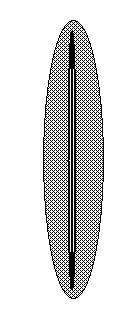

Figure 2: Pennate (left) and centric (right) forms of diatoms.
Ecology
As previously mentioned, diatoms are very abundant, largely existing wherever there is water. The study of extant diatom species, and particularly their ecologies, can provide useful information for the interpretation of palaeoenvironmental conditions.
Diatoms exhibit three major modes of existence:
- Planktonic
- Benthic (Lake/Sea/Ocean bed)
- Macrophytic (Attached to plants)
Planktonic forms contain oil globules, which help to keep the diatom afloat in the water column. As a result, it is often easier to identify dead diatoms, in which the internal oil globules and chloroplasts have decayed away to reveal the valve ornamentation, than it is to identify living diatoms to species level.
All diatom species are highly sensitive to environmental changes, giving rise to very different assemblages under rather tight environmental constraints. For example, diatoms display varying assemblages according to pH, trophic status, and pollution levels.
Diatoms bloom seasonally, with different species blooming at different times of the year.
Sampling
Where conditions are conducive, diatom remains will usually accumulate on lake/sea beds, and will often exhibit mixed assemblages, (i.e. consist of both benthic and planktonic forms, in addition to those brought in from tributary river/stream systems, and from soil in-wash). The best preservation conditions in terms of diatoms are those with any mixture of fine grained, anaerobic, and slightly acidic sediments.
Sampling is most frequently carried out by random core samples of a given area, as this preserves changes in the diatom assemblages over time. Where cores are sampled from beneath existing lakes, care should be taken to disturb the sediment-water interface as little as possible. Often a rich organic mud called gyttja, (typical of interglacial periods) will have accumulated, consisting of mainly faecal debris, animal and plant remains, along with some clastic component, (sand/silt/clay). Gyttja will retain a record of the most recent diatom activity.
Uses Of Diatoms
In general diatoms can be used to trace a variety of environmental phenomena, from changes in sea level, (whether brought about by climate change or tectonic activity), breaches of coastal barriers, (as a result of storms and/or sea-level rise), to the evaporation of lakes, (increasing salinity determining diatom assemblages). Below is an outline of their most prevalent uses.
Indicators of Salinity
- Marine
Some species are restricted to a very narrow range of salinities and are know as stenohaline species, others have no such restrictions and are known as cosmopolitan species. As a result, this causes zonation, which is particularly evident in estuaries, where a spectrum (and a gradient for such a spectrum) can be calculated from coastal to offshore species. This has applications in determining palaeo-fluvial environments, and sediment focusing. - Freshwater.
Some freshwater species will tolerate a little salt, and are known as halophilic, occurring in coastal lakes, or where the groundwater is rich in salts. However most freshwater species are stenohaline and will not tolerate salt.
Indicators of Productivity (Trophic Status)
There are several ways of deducing palaeotrophic status using diatoms:
- Total Diatom Count - This is relatively simple, the more diatoms there are in your sample, the more productive a given body of water is.
- Centric:Pennate Ratio - The more centrics there are in your sample, the more productive the environment is. (With the exception of a species called Cyclotella.)
- Indicator Species - Certain species are typical of certain conditions, for example Stephanodiscus is typical of eutrophic (abundant nutrient) conditions, and Tabellaria of oligotrophic (very low nutrient) conditions.
- Planktonic:Non-planktonic Ratio - Planktonic forms are more common in eutrophic lakes.
- Diversity Indicators - A low overall diversity amongst diatoms indicates stressful conditions, for example extreme trophic status (hyper-oligotrophic or hyper-eutrophic). However this could also indicate a source of pollution etc.
Indicators of Palaeo-pH
This perhaps the most important and most widely used application of diatom studies.
Diatoms are highly sensitive to pH and can illustrate differences of as little as 0.1 pH units. To accomplish this species are classified as either:
- Acidobiontic (Acid Living) pH < 7
- Acidophilous (Acid Preferring) pH ≤ 7
- Circumneutral pH = 7
- Alkaliphilous (Alkali Preferring) pH ≥ 7
- Alkalibiontic(Alkali Living) pH > 7
This method is highly dependant upon knowing the pH preference for all of the diatoms present, as the percentage of each of the above groups is measured and the ratios used to calculate a log index of the given population. With the use of some complicated mathematics this, in turn, can then be used to determine the palaeo-pH. Obviously, it is not always possible to know the preference of all of the species in your sample, and therefore this method can not always be applied.
Indicators of Palaeo-temperature
Diatoms are not very useful in determining changes in palaeo-temperature, due to the fact that the large majority of species will tolerate very wide ranges of temperature, typically from 0oC to 20oC.
That said, different assemblages are present when comparing warm and cold waters. However, this is almost certainly due to other overriding factors such as: incident solar radiation, water chemistry, pH, and nutrient availability.
Difficulties in Interpreting Diatom Samples
- Not all diatoms present in a body of water may settle out, they can be lost via outflows, dissolve, be crushed or eaten. In the best case scenario your assemblage is simply incomplete, or comparatively low in overall abundance. In the worst case scenario the ratios of different diatoms may be completely skewed, (for example planktonic forms with their oil-filled globules may be more prone to out-washing).
- Samples may contain diatoms washed in from outside your sample area, from soils, animal droppings, or tributaries. The sample becomes augmented, and in the worst case scenario may include indicator species contrary to the actual palaeo-environmental conditions.
- There may be insufficient silica dissolved in the body of water for diatoms to produce robust, preservable frustules, resulting in a complete absence in your sample.
- Taxonomy, especially in poorly preserved specimens, can often be difficult resulting in mis-identification and a chain of consequent errors.
- The ecology is not well known for all species, causing problems and/or errors with interpretation.
The Equifinality Conundrum
Equifinality: “is the principle that in open systems a given end state can be reached by many potential means.” [www.dictionary.com, accessed 20:20, 10/03/2007.]
In other words, different events give rise to the same outcome. For instance your interpretation of a diatom assemblage in a given sediment core indicates a rise in nutrients, however is it due to:
- Increased precipitation causing excessive run-off into the lake?
- Warmer weather causing an algal bloom, thereby releasing nutrients as they die off?
- A plethora of human activities - increased soil erosion from deforestation or ploughing, increased live-stocking densities in the catchment area resulting in higher effluent run-off, or accidental sewage/pollutant spillage?
Conclusions
Whilst diatom analysis is extremely useful in interpreting palaeo-environmental conditions, an integrated/holistic/multidisciplinary approach must be implemented to analyse all of the available data, whether proxy or direct.
References
Birks, H. J. B. et al. (1990) Diatoms and pH reconstruction. Philosophical Transactions of the Royal Society of London B. 327 1240, pp263-278.
Round, F. E., Crawford, R.M. & Mann, D.G. (1990) The Diatoms. Cambridge University Press, Cambridge.
Ryther, J. H et al.L (1958) The dynamics of a diatom bloom. Biological Bulletin 115, pp257-268.