In This Section
User login

New Duck-billed Dinosaur Species
A new, massive duck-billed dinosaur species has been discovered in Utah. Gryposaurus monumentensis (Gryposaurus “hook-beaked lizard”, monumentensis from Grand Staircase- Escalante National Monument where the fossils were found) from the Late Cretaceous had over 800 teeth.
More details at Utah Museum of Natural History
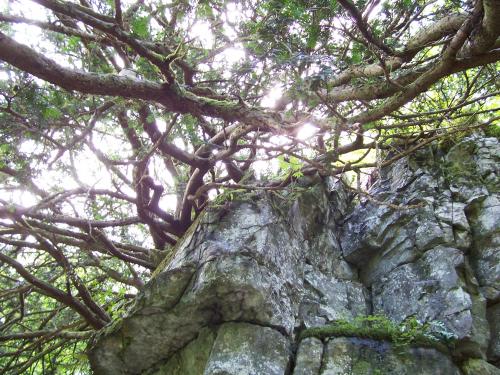
- Location: Ingleton Waterfalls Trail, North Yorkshire
- Date Taken (dd-mm-yy): 09/08/07.
This old Yew tree (Taxus baccata) was perched on a rocky overhang. Although it's roots definately penetrate the rock, and will cause cracks susceptible to freeze-thaw action, and the angular jointing of the rock (including the underside of one bedding plane) is well portrayed, I also added it because I'm very happy with the way the picture came out! I must have been having one of my Arty moments again.

This work is licensed under a Creative Commons Attribution-No Derivative Works 2.5 License.
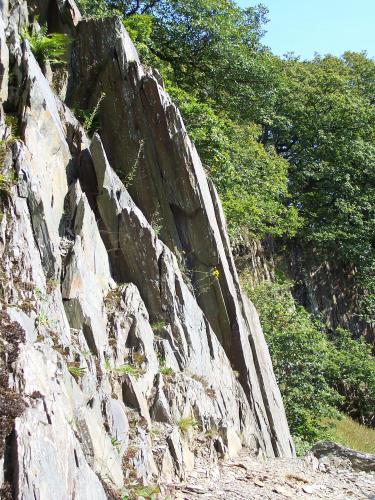
- Location: Ingleton Waterfalls Trail, North Yorkshire.
- Date Taken (dd-mm-yy): 09/08/07
Only a few tens of metres downstream from Baxenghyll Gorge, is this outcrop of steeply inclined slate of the Ingletonian Series. It is most probably Baxenghyll Slate.
This work is licensed under a Creative Commons Attribution-No Derivative Works 2.5 License.
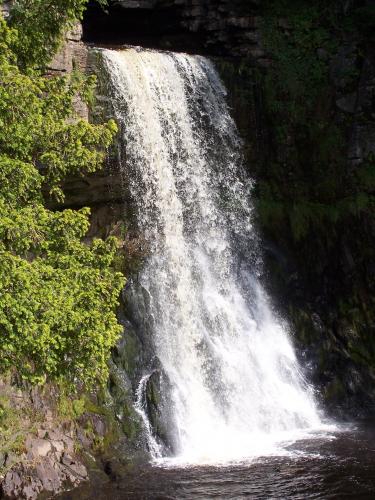
- Location: Ingleton Waterfalls Trail, North Yorkshire.
- Date Taken (dd-mm-yy): 09/08/07.
This work is licensed under a Creative Commons Attribution-No Derivative Works 2.5 License.
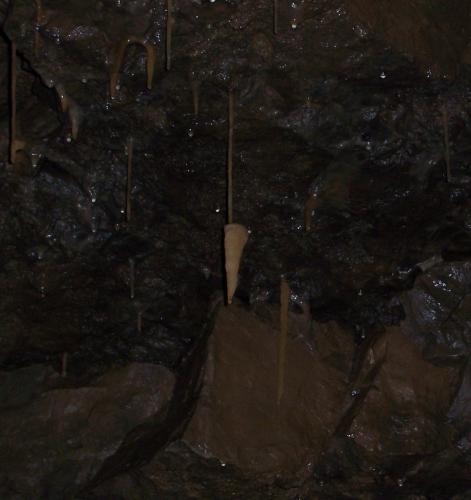
- Location: White Scar Caves, North Yorkshire.
- Date Taken (dd-mm-yy): 09/08/07
This rather dark photo shows another geologically interesting phenomenon. The thin pencil-like stalactites, termed straws, are actually hollow - with water dripping through them. One of these rather delicate structures (I hope it is obvious which), has become blocked and a "normal" stalactite has begun to form at its tip. It should be noted that although I use the phrase "One of..." above, that there are numerous occurrences of this phenomenon in the vicinity of the photographed example.
This work is licensed under a Creative Commons Attribution-No Derivative Works 2.5 License.
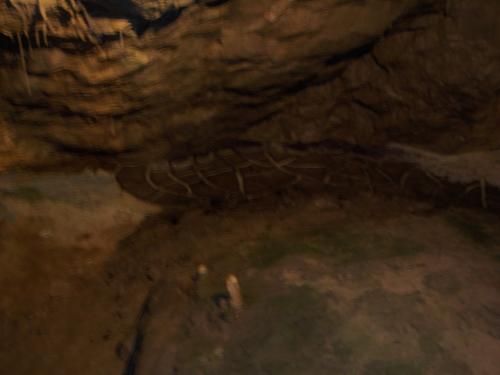
- Location: White Scar Caves, North Yorkshire.
- Date Taken (dd-mm-yy): 09/08/07
I apologise for the very fuzzy nature of this and the accompanying photo (damn autofocus). The only reason i have included them is because they are geologically interesting. There is evidence for there having been, at one time, a lake in Battlefield Cavern, which has now dried up (perhaps due to minor earth movements). The resultant polygonal cracks in the residual mud have begun to infill with pale coloured calcium carbonate. This is the only place in Europe where this phenomenon has been discovered. As a result the cracks have been designated a S.S.S.I.
This work is licensed under a Creative Commons Attribution-No Derivative Works 2.5 License.
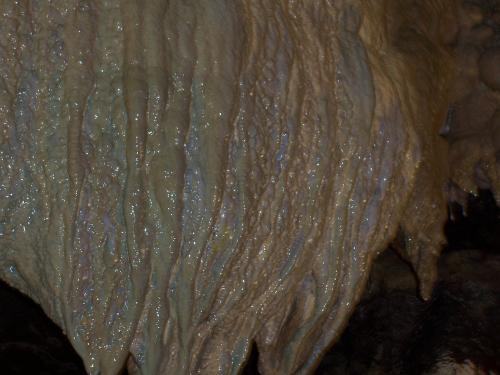
- Location: White Scar Caves, North Yorkshire.
- Date Taken (dd-mm-yy): 09/08/07
A structure called "The Devil's Tongue", we were told that the artificial lighting accounted for any green algal growth. However, I'm uncertain as to the source of the blue/purple hue. Whether it occurs as a result of camera flash or a mineral other than calcium carbonate being deposited I don't know.
This work is licensed under a Creative Commons Attribution-No Derivative Works 2.5 License.
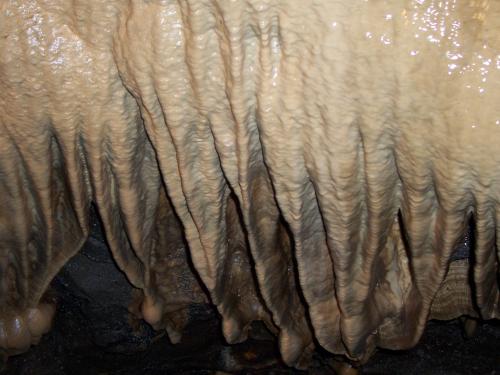
- Location: White Scar Caves, North Yorkshire.
- Date Taken (dd-mm-yy): 09/08/07
As in Flowstone Formation 1.
This work is licensed under a Creative Commons Attribution-No Derivative Works 2.5 License.
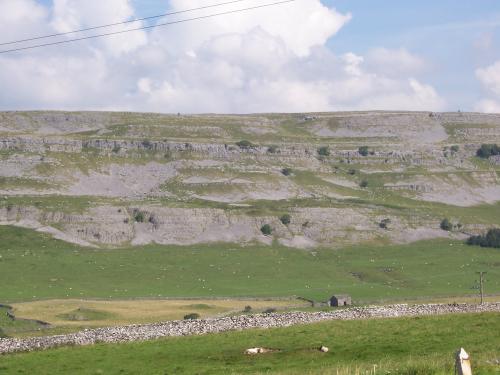
- Location: White Scar Caves, North Yorkshire
- Date Taken (dd-mm-yy): 09/08/07
Having returned from this year's holiday I thought I'd share a few of my snaps. Unfortunately I don't know much about the geology of the area I visited (which fortunately didn't stop me from enjoying it!). However if anybody wishes to know a little more about the area, I found this: http://www.fortunecity.com/greenfield/ecolodge/25/unfolding.htm to be helpful. Not too in depth so feel free to search for more if interested...
read more »
This work is licensed under a Creative Commons Attribution-No Derivative Works 2.5 License.
Forums Latest
Latest image