Hello all, I hope I've posted this in the right forum section (if not, I apologize)
I'm working with a small team over the net to design a new world- the project is much like, but unique from, what Tolkien did with Middle Earth. I love Middle Earth with a passion, but suffice it to say it has been overused (unfortunately) to the point of near stagnation. Tolkien was of course brilliant in many ways, but working alone he also lacked in certain areas of specialty- by his maps it seems as though he didn't take into account plate tectonics, erosion, or any standard processes by which any world is shaped.
In a new generation, I hope to form a world in which all manner of scientific scrutiny has been followed through to such a degree that it becomes difficult not to believe- a world of fantasy founded upon science in many respects.
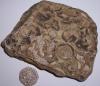
This is a cast of a sculpture I made- chunks of flattened clay make great tectonic plates for experimenting with:
I hope to make the environments in the world as stunning and varied as possible without compromising realism; mapping out exposed strata and mineral availabilities for different regions in a rational way, thinking through the plateaus, planning out the rain shadow deserts, tracing the rivers and deep cutting ravines as convincingly as possible.
My geology background isn't as strong as I would like it to be, but I know just enough to know that I don't know enough. I'm looking for somebody who would be willing to help us out- somebody with the expertise, creativity, and free time to have as much fun with this project as I do. We'll be expressing this world through an RPG, though of course the world itself is always of foremost importance.
Any takers? Please contact me if you're at all interested or have any questions.
Thanks,
-Blake Rieger
It sounds like an intriguing idea. Unfortunately, much as I would like to help, I have too many time constraints at the moment. I might lose my job in about a years time, so maybe then?
I might lose my job in about a years time, so maybe then?
What a cheery thought! At least you'll have more time for geology, eh?
Blake:
Like Gus, I think it's a great idea and I would love to help, but I don't have the time unfortunately. Welcome to the board, please keep us updated on progress and above all feel free to ask any questions
I might lose my job in about a years time, so maybe then?
Hmm... well, I've been working on this four years so far, so another year wouldn't kill me. Assuming everything doesn't get finished up in the mean time, I may have to take you up on that.
Thanks for the welcome, and you sir, by the way, are hilarious (I'm very good at lurking, and so I've come to realize this).
Jon,
Welcome to the board, please keep us updated on progress and above all feel free to ask any questions
Thanks. Actually, one of the tricky things I'm trying to work out right now is exactly where the fault lines would be located, and in which direction the plates would be moving. Forgive me, as I've pretty much forgotten all of the proper geological symbols for tectonics, but if you can at all make sense of any of these maps, I'd love some input:
I created a topographical map and a rough sketch of where I think fault lines would probably lie. A is being pushed under B and the melting crust is forming a plateau- as is C in respect to D. The others are pretty standard collisions welling up into mountains, and a few areas (C and E to an extent) are buckling and dipping lower in elevation in their center.
Anybody see any glaring issues? Anybody care to crack open MS paint or one of those nifty mapping programs and show me how to properly mark the movements of the plates and their submersions? I would guess arrows of some kind... but then showing that one plate is moving under another has me kind of stumped.
This might sound like a daft suggestion. get a popodum from your local Indian (Asian) Restaurant, hold it in both hands and break it up. What you'll get is it fracturing along lines of weakness, just like in plate tectonics. A simple experiment anyone can do in their own home and with the added advantage of being perfectly edible once you've photographed it. Not only that but it's circular. Fantastic. I'm going to eat one the next time I do a lecture on Cornish geology.
I (hope) you'll see that the fault lines are not simple - they are a complex of thrust structures that make up a fault zone. They also tend not to run along the crest of the moutains (as you have shown) but occur in the foreland region - where the subduction was happening.
I might find time to have a closer look next week: this is just off the top of my head
Along the fault lines path, I agree that the faults won't be at the mountains, and really they can't be for every plate. If you have a subduction forming a mountain chain on one side of a plate, chances are the other side is diverging with the plate adjacent to it. A plate cannot really be subducting and creating mountains on all of it's sides, as plates generally move in one direction, so the backside is normally moving away from that plate.
Sounds like a delicious plan. Unfortunately, standard papadum don't have the same variable plate thickness of said continent... so I wonder how reliable that would be (albeit still sufficiently tasty I'm sure).
Jon,
Wow, I completely overlooked the fact that faults are off to one side of a mountain- I can't believe I didn't remember that. Thank you for the links.
Now the tricky question is which side.
Katie,
Thanks. Hopefully somebody will stumble by here eventually with a bit more free time.
Love your signature quote so very true... oh, and geologists are nice is true too of course.
KU40,
I'm not entirely sure I follow... I'll have to read that again when I'm a little more awake I think- thanks for the suggestion either way (I'm sure it makes more sense than I can make of it at this hour).
I basically have the idea that these islands are being pinched by a much larger expanding ocean rift some distance off shore, though there may be a better explanation.
User info:
Fri, 02/10/2006 - 14:29
Dan Luna Rank: Calcite Joined: 17/04/2005 Points: 209
That might work, but I could see that resulting in too many unconformities... all of the strata would still be quite different. I don't think moving things around would make it much easier, in the grand scheme of things, to logically regress the terrain because of the problems with all of the different strata. It might help figuring out where to put some fault lines though, in regards to plate collisions- finding those exact collisions may be tricky if not impossible, however. Guess it can't hurt to give it a shot though, thanks.
Perhaps you could try starting with the tectonic plates, rather than the land masses. Make a series of constructive, destructive, collision & conservative boundaries, then try to think how the continental shelf will relate to them, and then draw in the land masses.
You could have
-Continents that are split in two by an ocean and a constructive margin, like America and Africa/Europe (note the rough fit of S.America and Africa.
-Mountain Ranges where oceanic plate subducts beneath continental (like the Andes.)
-Mountains where continental and continental crust collide (like the Himalayas.)
-Island Arcs where Oceanic subducts beneath oceanic
Once you've got these major features in place you can start to add the details of the coastlines, and oceanic island chains etc. Don't forget, you can have old mountain ranges where there are no plate boundaries, but these should be smaller and more worn down than the newwer ones.
Perhaps you could try starting with the tectonic plates, rather than the land masses.
I could, but I need those particular land masses- there are several reasons they are like that:
1. Artistic composition- contrasting the smaller mass against the dominant mainland.
2. Roughly circular/squared so it doesn't waste map space- having a long chain would be slightly less efficient because then position data would have to either be of varied resolution or have more bits in both directions- not to mention there would be a massive amount of ocean space unless It was cropped very close to the land.
3. For story purposes, every nation needs to be fairly close packed, but also separated by geological boundaries (the mountains, plateaus, ocean).
Not to mention I've already been using that map for a few years, so that could get confusing.
Thanks for the link though, that's a great reference image- and the ideas for plate convergence in relation to geological formations.
Those are all really large plates- what kind of difference is there when dealing with very small land areas? The whole thing is about 100 km across.
Don't forget, you can have old mountain ranges where there are no plate boundaries, but these should be smaller and more worn down than the newwer ones.
that map shows the point I was trying to make. if you look at the divergent boundaries, then look at their opposite boundary on the other side of the plate, generally it is convergant. The Nazca plate is an excellent example. The divergant boundary on the west side creates new crust, and the plate moves east, where it plunges under the South American plate just off the coast of Chile, forming the Andes mountains.
your map has mostly convergant boundaries creating mountains. you may want to throw in or move a couple fault lines in the middle of the oceans for divergent boundaries.
also having the faults connect on the ends to form actual plates would probably be good too. it's a tough one, though. i just tried drawing plate boundaries for about 10 minutes and wasn't satisfied with any of my results.
If the scale is only in the hundereds of km as part of a larger planet, you have no need for plate boundaries. The islands could be continental shelf islands a bit like the British Isles.
As a general structure for the main Island, how about a N-S trending Anticline, with bands of differing resistance. this would give you the central and the coastal mountains, with the flatter parts seperating them. A bit like this:
your map has mostly convergant boundaries creating mountains. you may want to throw in or move a couple fault lines in the middle of the oceans for divergent boundaries.
The island is based on Earth- it's supposed to be in the middle of an ocean. The reason it isn't still there is because it got removed by a spatial anomaly- stuck in a little bubble of time-space so to speak.
I had the thought that the divergent plate boundary of the mid-oceanic rift would provide enough thrust to buckle several smaller faulted areas together, like so:
The plate isn't really moving in every direction, but just moving slower relative to the others.
I'll try throwing in a few small divergent boundaries here and there to explain why some of the areas are rifting apart, good idea.
i just tried drawing plate boundaries for about 10 minutes and wasn't satisfied with any of my results.
I'd love to see what you came up with, if only to give me some ideas. Thanks for the attempt anyway.
Matt,
As a general structure for the main Island, how about a N-S trending Anticline, with bands of differing resistance.
Good idea... though could that form a reasonably localized central plateau? Maybe I can combine that with a small subduction fault or something... thanks for the tips.
I think I'm getting closer to figuring out where the faults should be... then there's just figuring out the strata in the rock, working out where and how things eroded, and fumbling with where resources would most likely be deposited. Heh'
You all wouldn't happen to know of any more good geology forums I can ask for help at do you? I don't think I'm experienced enough to do this adequately without spending a year brushing up on geology first (and I need to work on the critters more- I'm more of an evolutionary biologist than a geologist, so I can make some serious headway there).
I think Matt may have the best idea in not having major fault lines. given the relatively small scale of this world, it might be best to just deem it all on one plate and the mountains were built long before, along old faults that are no more. or at least have the main island on one plate, the smaller island on the lower left could be on another.
I'm just basing this off of a place similar to North America, which sits on one big plate, with the Rockies and other mountain ranges built long ago on old faults.
Good idea... though could that form a reasonably localized central plateau? Maybe I can combine that with a small subduction fault or something... thanks for the tips.
Depending on how it erodes, yeah it could form a plateau. I'm not sure about the subduction zone though.
Quote:
You all wouldn't happen to know of any more good geology forums I can ask for help at do you?
Well, by no means do they need to be active faults... I just need to know how to lay out fissures and unconformities in the strata- no to mention the layers themselves (such that rock types will be correct and the geological layers on cliffs will look right based on a larger scale model). I tend to think of fault lines (or past fault lines) as a first step in that... and imagining ancient faults is an important way of doing that... is it not? A few good oceanic trenches from dead faults might be nice too... I suppose they need not have all been there at the same time (would probably make more sense if they weren't). Maybe I'm off, heh'.
How could it have been eroded? I'm not sure if glaciers would fly, since it's in the ocean... but it is at roughly the longitude of France, and I believe there were a significant number of glaciers there at one time... seems like anything else wouldn't be very effective at creating plateaus inland. Do glaciers occur often on small islands?
This is the only good one I ever found!
Drat... I did Google for quite a while and was led to believe that... I suppose I was just hoping it wasn't so, heh'


Rank: Apatite
Joined: 02/08/2005
Points: 906
Hi Blake
It sounds like an intriguing idea. Unfortunately, much as I would like to help, I have too many time constraints at the moment. I might lose my job in about a years time, so maybe then?
Welcome to the forum.
Gus
Rank: Topaz
Joined: 18/12/2006
Points: 2986
I might lose my job in about a years time, so maybe then?
What a cheery thought! At least you'll have more time for geology, eh?
Blake:
Like Gus, I think it's a great idea and I would love to help, but I don't have the time unfortunately. Welcome to the board, please keep us updated on progress and above all feel free to ask any questions
Jon
Geologists are gneiss!!
Rank: Talc
Joined: 09/02/2006
Points: 11
Gus,
I might lose my job in about a years time, so maybe then?
Hmm... well, I've been working on this four years so far, so another year wouldn't kill me. Assuming everything doesn't get finished up in the mean time, I may have to take you up on that.
Thanks for the welcome, and you sir, by the way, are hilarious (I'm very good at lurking, and so I've come to realize this).
Jon,
Welcome to the board, please keep us updated on progress and above all feel free to ask any questions
Thanks. Actually, one of the tricky things I'm trying to work out right now is exactly where the fault lines would be located, and in which direction the plates would be moving. Forgive me, as I've pretty much forgotten all of the proper geological symbols for tectonics, but if you can at all make sense of any of these maps, I'd love some input:
I created a topographical map and a rough sketch of where I think fault lines would probably lie. A is being pushed under B and the melting crust is forming a plateau- as is C in respect to D. The others are pretty standard collisions welling up into mountains, and a few areas (C and E to an extent) are buckling and dipping lower in elevation in their center.
Anybody see any glaring issues? Anybody care to crack open MS paint or one of those nifty mapping programs and show me how to properly mark the movements of the plates and their submersions? I would guess arrows of some kind... but then showing that one plate is moving under another has me kind of stumped.
Thanks,
-Blake
Rank: Apatite
Joined: 02/08/2005
Points: 906
This might sound like a daft suggestion. get a popodum from your local Indian (Asian) Restaurant, hold it in both hands and break it up. What you'll get is it fracturing along lines of weakness, just like in plate tectonics. A simple experiment anyone can do in their own home and with the added advantage of being perfectly edible once you've photographed it. Not only that but it's circular. Fantastic. I'm going to eat one the next time I do a lecture on Cornish geology.
Gus
Rank: Topaz
Joined: 18/12/2006
Points: 2986
Have a look at:
http://en.wikipedia.org/wiki/Geology_of_the_Himalaya
http://en.wikipedia.org/wiki/Orogeny
I (hope) you'll see that the fault lines are not simple - they are a complex of thrust structures that make up a fault zone. They also tend not to run along the crest of the moutains (as you have shown) but occur in the foreland region - where the subduction was happening.
I might find time to have a closer look next week: this is just off the top of my head
Jon
Geologists are gneiss!!
Rank: Feldspar
Joined: 01/06/2004
Points: 1090
What a good idea! I'm also rather busy but I'm happy to listen to any suggestions and give my input if I think of anything useful to say
Oh and welcome to GeologyRocks!
Katie
"Nothing in biology makes sense, except in the light of evolution" - T. Dobzhansky
Rank: Calcite
Joined: 26/09/2005
Points: 138
Along the fault lines path, I agree that the faults won't be at the mountains, and really they can't be for every plate. If you have a subduction forming a mountain chain on one side of a plate, chances are the other side is diverging with the plate adjacent to it. A plate cannot really be subducting and creating mountains on all of it's sides, as plates generally move in one direction, so the backside is normally moving away from that plate.
Rank: Talc
Joined: 09/02/2006
Points: 11
Gus,
Sounds like a delicious plan. Unfortunately, standard papadum don't have the same variable plate thickness of said continent... so I wonder how reliable that would be (albeit still sufficiently tasty I'm sure).
Jon,
Wow, I completely overlooked the fact that faults are off to one side of a mountain- I can't believe I didn't remember that. Thank you for the links.
Now the tricky question is which side.
Katie,
Thanks. Hopefully somebody will stumble by here eventually with a bit more free time.
Love your signature quote so very true... oh, and geologists are nice is true too of course.
KU40,
I'm not entirely sure I follow... I'll have to read that again when I'm a little more awake I think- thanks for the suggestion either way (I'm sure it makes more sense than I can make of it at this hour).
I basically have the idea that these islands are being pinched by a much larger expanding ocean rift some distance off shore, though there may be a better explanation.
Rank: Calcite
Joined: 17/04/2005
Points: 209
Maybe it would be easier to base your world on the Earth, but move bits around, change their shape, age them etc. until it becomes unrecognisable.
Don't ask me - I wouldn't know a maar from a hole in the ground.
Rank: Talc
Joined: 09/02/2006
Points: 11
That might work, but I could see that resulting in too many unconformities... all of the strata would still be quite different. I don't think moving things around would make it much easier, in the grand scheme of things, to logically regress the terrain because of the problems with all of the different strata. It might help figuring out where to put some fault lines though, in regards to plate collisions- finding those exact collisions may be tricky if not impossible, however. Guess it can't hurt to give it a shot though, thanks.
Rank: Calcite
Joined: 29/01/2006
Points: 152
Perhaps you could try starting with the tectonic plates, rather than the land masses. Make a series of constructive, destructive, collision & conservative boundaries, then try to think how the continental shelf will relate to them, and then draw in the land masses.
http://facweb.bhc.edu/academics/science/harwoodr/GEOL101/labs/PlateTecto...
You could have
-Continents that are split in two by an ocean and a constructive margin, like America and Africa/Europe (note the rough fit of S.America and Africa.
-Mountain Ranges where oceanic plate subducts beneath continental (like the Andes.)
-Mountains where continental and continental crust collide (like the Himalayas.)
-Island Arcs where Oceanic subducts beneath oceanic
Once you've got these major features in place you can start to add the details of the coastlines, and oceanic island chains etc. Don't forget, you can have old mountain ranges where there are no plate boundaries, but these should be smaller and more worn down than the newwer ones.
Rank: Talc
Joined: 09/02/2006
Points: 11
Matt,
Perhaps you could try starting with the tectonic plates, rather than the land masses.
I could, but I need those particular land masses- there are several reasons they are like that:
1. Artistic composition- contrasting the smaller mass against the dominant mainland.
2. Roughly circular/squared so it doesn't waste map space- having a long chain would be slightly less efficient because then position data would have to either be of varied resolution or have more bits in both directions- not to mention there would be a massive amount of ocean space unless It was cropped very close to the land.
3. For story purposes, every nation needs to be fairly close packed, but also separated by geological boundaries (the mountains, plateaus, ocean).
Not to mention I've already been using that map for a few years, so that could get confusing.
Thanks for the link though, that's a great reference image- and the ideas for plate convergence in relation to geological formations.
Those are all really large plates- what kind of difference is there when dealing with very small land areas? The whole thing is about 100 km across.
Don't forget, you can have old mountain ranges where there are no plate boundaries, but these should be smaller and more worn down than the newwer ones.
Thanks, I'll keep that in mind.
Rank: Calcite
Joined: 26/09/2005
Points: 138
that map shows the point I was trying to make. if you look at the divergent boundaries, then look at their opposite boundary on the other side of the plate, generally it is convergant. The Nazca plate is an excellent example. The divergant boundary on the west side creates new crust, and the plate moves east, where it plunges under the South American plate just off the coast of Chile, forming the Andes mountains.
your map has mostly convergant boundaries creating mountains. you may want to throw in or move a couple fault lines in the middle of the oceans for divergent boundaries.
also having the faults connect on the ends to form actual plates would probably be good too. it's a tough one, though. i just tried drawing plate boundaries for about 10 minutes and wasn't satisfied with any of my results.
Rank: Calcite
Joined: 29/01/2006
Points: 152
If the scale is only in the hundereds of km as part of a larger planet, you have no need for plate boundaries. The islands could be continental shelf islands a bit like the British Isles.
As a general structure for the main Island, how about a N-S trending Anticline, with bands of differing resistance. this would give you the central and the coastal mountains, with the flatter parts seperating them. A bit like this:
Rank: Talc
Joined: 09/02/2006
Points: 11
KU40,
your map has mostly convergant boundaries creating mountains. you may want to throw in or move a couple fault lines in the middle of the oceans for divergent boundaries.
The island is based on Earth- it's supposed to be in the middle of an ocean. The reason it isn't still there is because it got removed by a spatial anomaly- stuck in a little bubble of time-space so to speak.
I had the thought that the divergent plate boundary of the mid-oceanic rift would provide enough thrust to buckle several smaller faulted areas together, like so:
The plate isn't really moving in every direction, but just moving slower relative to the others.
I'll try throwing in a few small divergent boundaries here and there to explain why some of the areas are rifting apart, good idea.
i just tried drawing plate boundaries for about 10 minutes and wasn't satisfied with any of my results.
I'd love to see what you came up with, if only to give me some ideas. Thanks for the attempt anyway.
Matt,
As a general structure for the main Island, how about a N-S trending Anticline, with bands of differing resistance.
Good idea... though could that form a reasonably localized central plateau? Maybe I can combine that with a small subduction fault or something... thanks for the tips.
I think I'm getting closer to figuring out where the faults should be... then there's just figuring out the strata in the rock, working out where and how things eroded, and fumbling with where resources would most likely be deposited. Heh'
You all wouldn't happen to know of any more good geology forums I can ask for help at do you? I don't think I'm experienced enough to do this adequately without spending a year brushing up on geology first (and I need to work on the critters more- I'm more of an evolutionary biologist than a geologist, so I can make some serious headway there).
Rank: Calcite
Joined: 26/09/2005
Points: 138
I think Matt may have the best idea in not having major fault lines. given the relatively small scale of this world, it might be best to just deem it all on one plate and the mountains were built long before, along old faults that are no more. or at least have the main island on one plate, the smaller island on the lower left could be on another.
I'm just basing this off of a place similar to North America, which sits on one big plate, with the Rockies and other mountain ranges built long ago on old faults.
Rank: Calcite
Joined: 29/01/2006
Points: 152
Good idea... though could that form a reasonably localized central plateau? Maybe I can combine that with a small subduction fault or something... thanks for the tips.
Depending on how it erodes, yeah it could form a plateau. I'm not sure about the subduction zone though.
You all wouldn't happen to know of any more good geology forums I can ask for help at do you?
This is the only good one I ever found!
Rank: Talc
Joined: 09/02/2006
Points: 11
Well, by no means do they need to be active faults... I just need to know how to lay out fissures and unconformities in the strata- no to mention the layers themselves (such that rock types will be correct and the geological layers on cliffs will look right based on a larger scale model). I tend to think of fault lines (or past fault lines) as a first step in that... and imagining ancient faults is an important way of doing that... is it not? A few good oceanic trenches from dead faults might be nice too... I suppose they need not have all been there at the same time (would probably make more sense if they weren't). Maybe I'm off, heh'.
How could it have been eroded? I'm not sure if glaciers would fly, since it's in the ocean... but it is at roughly the longitude of France, and I believe there were a significant number of glaciers there at one time... seems like anything else wouldn't be very effective at creating plateaus inland. Do glaciers occur often on small islands?
This is the only good one I ever found!
Drat... I did Google for quite a while and was led to believe that... I suppose I was just hoping it wasn't so, heh'
Thanks for all of your help, I won't lose heart.