In This Section
User login

General Geology
Limestone
A rock composed mainly of calcium carbonate CaCO3. Limestones comprise a large variety of rocks including carbonate muds and oozes, chalks, ooliths and bioclastic limestone. They form in a variety of environments from deep sea (but above the carbonate compensation depth), temperate seas, tropical sea, lakes and rivers. Most caves are found in limestones due to erosion by acidic water. Limestones erode into karst topography.
read more »Limestone Pavement
A formation found in areas of karstic topography where limestone has dissolved into pavement-like blocks. The dissolution occurs along joints forming grykes. This leaves blocks called clints.
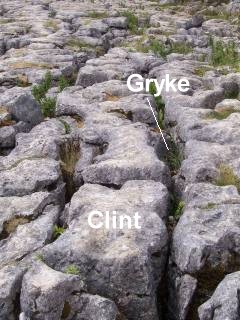
Picture courtesy of Benauld.
Lithification
The process of turning loose sediment into a sedimentary rock. This is done by heat, pressure and time. This process can take from years to millions of years. Hardgrounds are formed in inter-tidal carbonates and can form in years. Usually this process is a slow one. If this process continues, metamorphism occurs.
Lithosphere
The outer, rigid shell of the earth. It is composed of the entire crust and uppermost part of the mantle. The thickness of the lithosphere varies from around 5km to up to 100km where there is thick continental crust. The lithosphere is above the more ductile asthenosphere. The boundary between these two layer is the Mohorovicic discontinuity.
The lithosphere is fragmented into tectonic plates which move relative to one another. This movement of lithospheric plates is described as plate tectonics.
read more »Magma
A melt, generally containing suspended crystals and other volatiles, formed by total or partial melting of solid mantle or crustal material.
Mantle
The layer beneath the crust, but above the core in the interior of the Earth. It's composition is broadly that of ultrabasic rocks.
read more »Mare
Area of dark basaltic lava on the Moon (pl. Maria).
Mesozoic
Era comprising the Triassic, Jurassic and Cretaceous, spanning 245-65Ma.
Mineral
A naturally occurring homogeneous solid with a highly ordered lattice and of a defined chemical composition.
Mohorovičić discontinuity
The Mohorovičić discontinuity, usually referred to as the Moho, is the boundary between the Earth's crust and the mantle. The Moho serves to separate both oceanic crust and continental crust from underlying mantle. The Mohorovičić discontinuity was first identified in 1909 by Andrija Mohorovičić, a Croatian seismologist, when he observed the abrupt increase in the velocity of earthquake waves (specifically P-waves) at this point.
read more »Forums Latest
Latest image