 GeologyRocks
Forests on top of glaciers?
- Login to post a new forum topic.
Rank:

Contact:

Now on *top* of
Wed, 08/28/2013 - 16:41Now on *top* of glaciers...
That is a very pretty vision - I'm not sure it has ever actually happened though (because forests take a long time to form and even grass might have difficulty with little to no surface water)
Just applying my basal biological knowledge with general principles (i.e rocks tend to go to the bottom of glaciers because they're a lot denser than ice) (note I could be wrong on this) - I reckon a lot of the soil would either be frozen or not near the surface of the galcier which would prohibit any major plant growth. glaciers also tend to be in pretty cold regions that prohibit anything except tundra.
It may be possible to get some hardy grasses growing on a a glacier if their roots can penetrate down deep enough but then again grasses tend to have quite superficial (near the surface) root systems (with a few exceptions). I'm not sure if there's any evidence (I'm not a geologist remember!) of massive sustained glacial flora - but there may be!
Given that massive glaciers will take a very long time to reach the end of their flows, if there is a large amount of soil on top and at least a little liquid water then you should be able to get some small floral growth - mosses, fungi, grasses. Given that the soil is likely to be frozen for a good portion of hte year - if there were topsoil - I imagine it would be of a sort of tundra-like growth cycle: not much growing except hardy grasses and the occasional xenophilic bush.
I havent googled the subject yet - I'll have a gander through the uni library once I get a chance xD
Any of the other folks know anything? I so want this to be a real thing; it just sounds like so much fun!
Rank:

Contact:
Drumlins are actually quite
Thu, 08/29/2013 - 07:05Drumlins are actually quite problematical but one thing is certain: they've got nothing to do with forests growing on top of glaciers. The typical egg-shaped feature which occurs in swarms could have a number of origins (for example they could be formed by ice advance or retreat) but they basically consist of ill-sorted "rubbish" which has been scraped from under an ice sheet and deposited elsewhere whilst the ice was on top of it, as oppsed to a moraine which is where rubbish has been moved in front of or at the sides of an ice sheet. My favourite theory about drumlin formation is that they represent the lenses of jellified ice (which it could be under enormous pressure) which allow an ice sheet to move; when the ice sheet melts they get replaced by the rubbish mentioned above as a late stage in their development.
Rank:
Contact:
How much liquid water is
Thu, 08/29/2013 - 10:44How much liquid water is there on or near a glacier (as in directly associate with it) (and how much of it is a liquid due to high pressue phase transiition)?
I'm merely curious - If there is liquid water I'd be surprised if there werent some sort of endigenous bacteria attempting to colonise it (and doing it very slowly because of low temperatures  )
)
--edit-- apparently a lot of alpine glaciers act as water reservoirs across the seasons: storing water in a frozen form during the winter and releasing it as meltwater during the summer - in places where water would otherwise be scarse.
Ps - the more I look into it the less likely it seems to have plants growing on the glacier itself (nearby, yes); something obvious I never thought of was nutrients - ice doesnt really have any of them. Okay, well it can, but it's generally stuck in the ice and innaccessable to the pioneering plants; but glacial ice is mostly from snow so it's not had a chance to leech nutrients from the soil at any point.
Pps - Drumlins are pretty weird... I mean that in the best possible way btw!
Rank:
Contact:
I agree, drumlins are weird,
Thu, 08/29/2013 - 11:34I agree, drumlins are weird, but then so are a lot of glacial features. The problem with studying them is it's very difficult if not impossible to see what's happening below an ice sheet (noticer I say "ice sheet" rather than glacier because drumlins tend to form under the former).

Rank:
Contact:

I'm afraid my radar is in
Thu, 08/29/2013 - 20:39I'm afraid my radar is in for repair right now.
There may be surface water during summer days on top of a glacier at lower altitudes, but that would either re-freeze at night if it hadn't flowed down any nearby crevasse.
I feel little could grow on a glacier because of the constant movement, the topography (rarely a smooth top, mostly peaks and crevasses opening and closing with the flow) and the lack of top soil. Maybe the odd sprig of tough grass, but a forest - no.
John
“Civilisation exists by geological consent, subject to change without notice.” - Will Durant
Rank:
Contact:
I'm still a bit confused how
Fri, 08/30/2013 - 07:46I'm still a bit confused how we get from drumlins to forests. There are no glaciers or ice sheets with forests currently on the planet so there's no evidence that was the case in the past. And before anyone says "but the present isn't always a clue to the past", I think it would apply in this case.
Rank:
Contact:
Still Here
Mon, 09/02/2013 - 16:42No. I'm the original poster and I'm still here. I'm also not an expert but I can explain my logic that led to the original post.
I was taught that drumlins were deposited by the trailing edge of receding glaciers. In Central New York where there is a big cluster of drumlins there are also several lakes formed by waterfalls coming off the edge of the receding glacier. The most famous such lake is Green Lake in NY's Green Lake State Park.
Because of those lakes, I figure that there must have been big rivers on top of the ice, and that those rivers would have carved canyons. Gravel and soil dispersed in the ice would be exposed as the canyon walls formed and would roll downhill to the bottom. Deep pockets could have formed in the canyon bottoms, just as in conventional land-based rivers. Soil and gravel in those river bottom pockets would be the origin of those drumlins.
By analogy, think of the river bottom pocket that filled with mud and dinasaur bodies that formed "The Quary" in today's Dinosaur National Monument. Same process, but with a river on land rather than on ice. In general I see no reason why the evolution of river beds on ice surfaces should be different than the evolution of river beds on land.
The pockets need not be the exact shape of drumlins but they would be about the same volume and they would be several hundred feet thick. As the rivers dried out, or meandered to a different spot, they would be exposed to the air, and thus make fertile ground for things to grow. Their thickness would insulate them from the cold.
But how many such canyons? A half dozen or hundreds? I think of hoodoos in Bryce Canyon and how each started with a stream of water coming off the edge of a plateau. Those streams didn't choose a single channel to make deep canyons, they formed hundreds of pockets and prominences only a few hundred meters apart (at least at Bryce). My point is that the erosion process in Bryce didn't favor one or two gullies and prominences, it created hundreds in the span of a few miles. Again I'm thinking that ice top river and land top rivers have similar erosion patterns.
Eventually each pocket would work its way down to the land surface and be deposited as a drumlin.
If gravel and soil were dispersed in the ice without the pocket process above, then I would expect them to be deposited dispersed on land as the ice melted. They would not form features like drumlins.
So, everything I've said is coupled to the mechanics of drumlin formation. If I'm wrong on that, then everything about this thread is off base.
Rank:
Contact:
First I must apologise for
Tue, 09/03/2013 - 11:45First I must apologise for the comment about you clearing off, it's happened in the past a fair bit - someone posting a question and then disappearing.
I can see how your logic is working but drumlins aren't necessarily formed by ice retreat and the reverse could be true - they could be formed by advancing glaciers and represent the "lubricated blobs" (for want of a better way of describing them) which would allow an ice sheet to move. When the ice melts features such as these are often exposed as "negatives" of their original shape. Look up "esker" as a good example of a negative ice feature which is where an ice cave has filled with debris during glacial retreat and leaves a meandering ridge.
Rank:
Contact:
Perhaps drumlins distract from the original point?
Tue, 09/03/2013 - 18:43Thanks for your reply. See the sattelite picture here showing the drumlin field in New York. They don't appear in chains like eskers.
http://upload.wikimedia.org/wikipedia/commons/0/0c/Drumlinfield_large.jpg
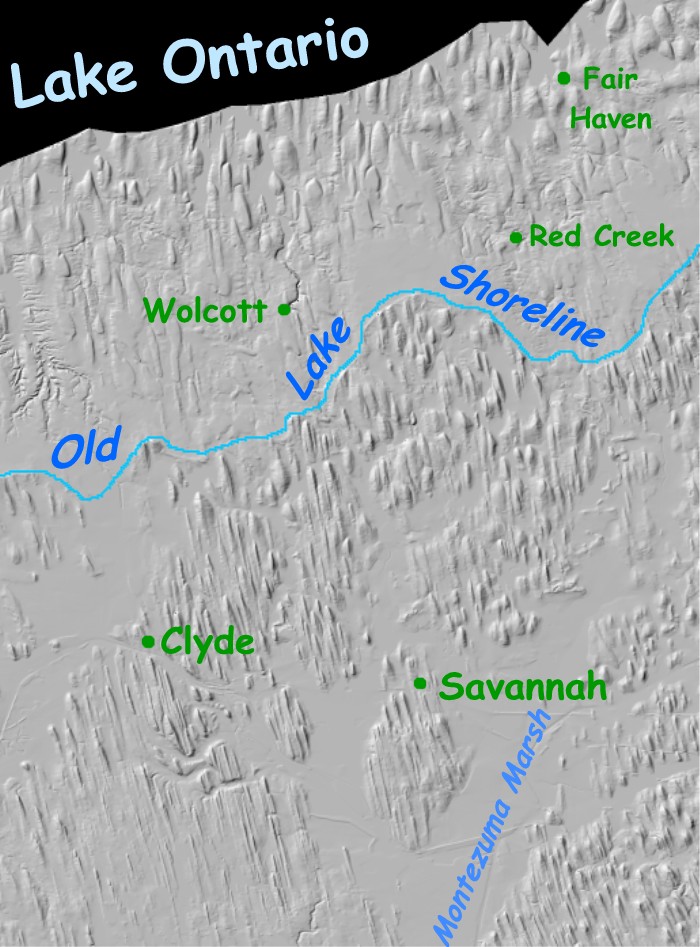
Might drumlins in different places been formed by different processes?
Remember that my original post had to do with things growing. It doesn't directly relate to drumlins but rather whether the soil carried by the glacier must be sub-ice-surface or where it could have been exposed to air on top of the ice at any time during the glacier's life.
What kind of evidence would demonstrate that? The only thing I can think of is fossil remains of organic matter dated to a period where the region was known to be under a glacier. Glacier top rivers, canyons, tunnels, gardens or any other ice surface features would leave little or no evidence behind.
Rank:
Contact:
Eskers form under glaciers,
Wed, 09/04/2013 - 12:20Eskers form under glaciers, drumlins under ice sheets, the point being that the two features are "negatives" of cavities under the ice which become filled with "rubbish" when the ice melts. Most debris within glaciers is on the move and at a speed which would mitigate against the development of a root sysytem which would sustain trees. I've camped on a glacier and was kept awake all night by the constant creaking and groaning of the ice as it moved. Also most soil etc is scraped from the sides and bottom of a glacier and tends to remain as either trapped ribbons moving parallel to the ice flow (later to become lateral moraines) or pushed at the front (terminal moraine), the remainder being contained within the ice which probably contributes to eskers and similar features. Notice that I'm referring to glaciers here. Ice sheets travel via a different mechanism, so that whilst glaciers are confined between valley sides and move in a downhill direction, ice sheets tend to spread outwards in all directions and form massive fronts hundreds of miles across. However, in both cases, due to movement, temperature, lack of suitable material, or altitude, would the conditions develop for forests or "gardens" to form. The best you could hope for is a few extremely hardy alpine plants or lichens to survive.
Rank:

Contact:

Forests on top of glaciers?
Submitted by Anorlunda on Wed, 08/28/2013 - 16:14.I am struck by the tremendous number of drumlins in the Central New York region. There must have been a huge quantity of dirt and gravel scraped up by those glaciers. That thought brings to mind images of fields and forests growing on top of the glaciers. My question: is there any evidence of that?
Perhaps there are places in the world today where fields and forests grow on top of glaciers. Right?