 GeologyRocks
PLEASE HELP ME!!! "Basic" but yet impossible assignments!
- Login to post a new forum topic.

Rank:

Contact:


Can you send the link for
Tue, 08/21/2012 - 09:09Can you send the link for the picture again. Nothing happens this end, and I suspect - since the question appears to be gobblegook at present - the answer lies in the picture.
Still not sure I can aswer this. I don't understand why its not Googoleable
At one point you have written 'axle' did you mean 'axis'?
John
“Civilisation exists by geological consent, subject to change without notice.” - Will Durant
Rank:

Contact:
Try this one!
Tue, 08/21/2012 - 09:51Try this one!
http://i47.tinypic.com/kd934o.gif
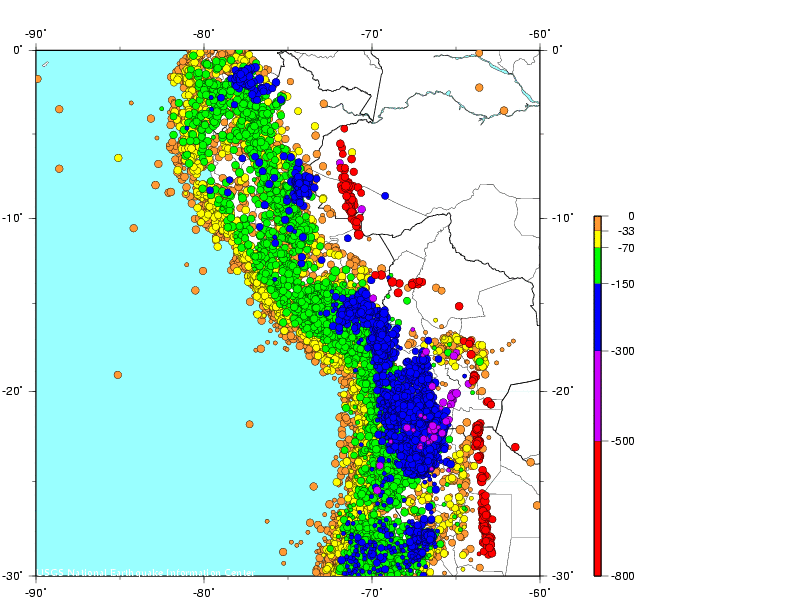
Yes, most likely. My apologies, my english isn't what it used to be.

Rank:

Roles:


Contact:

From the image (where colour
Tue, 08/21/2012 - 22:21From the image (where colour depicts depths of earthquake) you can see that the quakes deepen to the west/north west. If we assume that the quakes occur in the subducting plate (pretty reasonable) then you can work out the depth of the subducting plate at various locations (like 20 degrees south, 70 degrees west: 20 S 70 W).
The vertical slope you can work out by looking at the vertical change in the subducting plate at 20 S. You'll need to convert degrees to km to get an angle, but you can certainly say what the depth change is in the vertical easily.
The other two questions are easier: you have an age and a distance, so a rate is simply distance/age.
For the last one: use google: the first hit (Wikipedia) should do the trick 
Rank:
Contact:
Thank you for your
Tue, 08/21/2012 - 23:12Thank you for your answer!
Unfortunatly, I still don't really get it. We haven't even reached the earthquake chapter yet.
First of all, I cannot see the quake pointing in any direction at all, and isn't the blue/purple dots representing deeper areas than gree/yellow/orange? I mean I don't see any pattern which I can perceive as the subduction pointing west? More east if so, since the orange dots seems to form some kind of shore.
How do I convert degrees to an angle? I mean, the only unit I find is km representing how deep the different colours in the scale to the right are. Nothing at all about distance. I probably wouldn't be able to calculate it anyway though. But thank you very much anyway!
Yes, that one I actually figured out during the day! 
Concerning the Blackett-question, I got a little bit confused since the available answers were:
1. Magnetic reversals
2. Mapping of the ocean floor
3. Suggested sea-floor spreading
4. Understood the importance of magnetic anamolies
According to our computerbased lectures he on the other hand discovered polar wander paths, and if I remember correctly the wikipedia article held him as inventor of some kind of tool to study ocean floor.
Again, thanks for answering, this has been bugging me for 26 hours now!
Regards, SirYxes
Rank:
Roles:
Contact:
subduction
Wed, 08/22/2012 - 05:22More east if so, since the orange dots seems to form some kind of shore.
I meant east - honest
So if we look at a subducting plate: http://en.wikipedia.org/wiki/File:SubZone.jpg
Then the depth of the earthquakes trace the path of the plate.
How do I convert degrees to an angle? I mean, the only unit I find is km representing how deep the different colours in the scale to the right are. Nothing at all about distance.
Well you question said "vertical slope", which is vague at best. Slope is usually in degrees, so a bit of trig to work out the angle (or slope) using the vertical distance (colour of the dots) and the horizontal distance (convert the degrees longitude from the first dot to the last dot along 20S, remembering to convert degrees longitude to distance in km's first). Or the question might just mean the maximum vertical depth at 20S. No idea. You guess is as good as mine.
Rank:

Contact:

PLEASE HELP ME!!! "Basic" but yet impossible assignments!
Submitted by SirYxes on Mon, 08/20/2012 - 23:26.Hey you guys! Im aware how bad it might look like when a newly-registred user asks for help like this, but I really got no choice. See, the thing is, Im taking this internet class in basic geology, but Im finding myself totally unable to even try to guess the answers to this test. I have have read the chapter in the only text book "earth: portrait of a planet" about this subject a million times already, googled like crazy but still no luck!
I would really appreciate it indescribely much if anyone would be able to help out with any of theese questions. I am genuinly interesed in the earth, and not a lazy at all.
http://i.imgur.com/iEzOa.gif
What is the approximate direction of the subduction at 20 S 70 W?
What is the approximate vertical slope of the subduction along with 20 s?
Focal depths of earthquakes along a subduction zone (unit: km)
Based on the Brunhes / Matuyama magnet reversed area is 11.7 km from the back axle in the Central Atlantic, how fast moving seabed away from the back axle?
Based on the Matuyama / Gauss magnetic reversed area is 38.7 km from the back axle in the Central Atlantic, what is the rate of spreading of the back? Absolute age of Brunhes / Matuyama magnet reversed integers: 0.78 M.yr. (millions of years)
Absolute age Matuyama / Gauss magnetic reversed integers: 2.58 M.yr. (millions of years)
What part of the discovery of plate tectonics did Patrick Blackett contribute to?
Thank you dearest anyone whom might reply!