











 About the Authors & SitePrivacy
Submissions
About the Authors & SitePrivacy
Submissions
All Rights Reserved


How does oil form?
| Submitted by: | Abdul-rhman |
| Date: | 2003-05-18 |
| Answered By: | Jon Hill (University of Edinburgh) |
Oil formation is basically heat and time acting on organic carbon. Oil, natural gas and coal are all hydrocarbons, which are complex molecules of hydrogen, oxygen and carbon, strung out into what are called polymers. The organic carbon comes mainly from small marine animals. As the animals die, they fall to the sea bed and get buried by more sediment and animal debris. This is what will eventually form the source rock. This is the rock that must be subject to heat and time in order to produce oil. The type of organic matter determines the type of hydrocarbon produced (table 1). You can actually make oil from this source rock by heating it manually, but the energy required to do this is more than the energy you get from burning the oil. However, this has been done on an industrial scale in some places, for example in the Lothian Oil Shale field, where up to 2.1 million barrels a year were produced in the First World War.
| Kerogen Type | H:C ratio | O:C ration | Source | Hydrocarbon produced |
| I | High | Low | Mature algae | Light Oil |
| II | High | High | Algae, spores, cuticle | Heavy Oil and some gas |
| III | Low | High | Land plants | Gas |
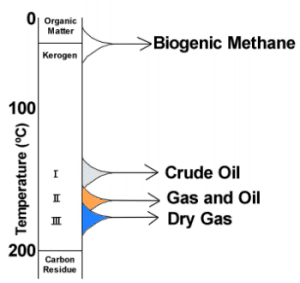
A typical source rock in the UK is the Kimmeridge Clay, a late Jurassic deposit. This rock has about 7% carbon, which is very rich for a clastic rock. This rock then needs to get to about 100-200° centigrade in order to mature (fig 1). Maturation breaks down the large molecules to simpler ones and the type of molecules present determine the type of oil (and hence its use after refinement) produced by a reservoir.
|
||
|
 |
|
|
Figure 1: The maturation of the various kerogen types. Colours same as table 1. | |
|
||
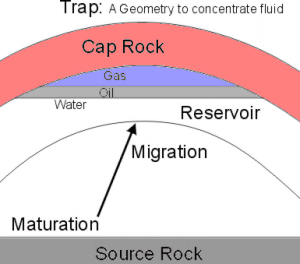
After maturation, the oil must migrate from the source, to a reservoir rock, which must be capped by an impermeable rock. This sequence of rocks is called the trap (fig 2).
|
||
|
 |
|
|
Figure 2: The relationship between source, reservoir, cap and trap. | |
|
||
Discuss this further in the forums.
| Tutorials | Pictures | Fun & Games | Forum | Q & A | Links |
Email: [email protected] or [email protected]

